

Table of Contents
- What Off Market Properties Are and Why Bend Buyers Want Them
- Step 1: Build Your Off Market Property Search Tools Stack
- Step 2: How to Contact Homeowners Directly With Outreach Templates
- Step 3: Real Estate Direct Mail Marketing That Gets Responses
- Step 4: Driving for Dollars in Bend Neighborhoods
- Step 5: Network With Local Investors and Real Estate Agents
- Legal Protections and Due Diligence for Off Market Buyers
- Financing Off Market Deals in Bend and Deschutes County
- On Market vs Off Market: Which Path Fits Your Bend Search
- Conclusion: Start Your Bend Off Market Search
- Frequently Asked Questions
Last Updated: September 25, 2026
What Off Market Properties Are and Why Bend Buyers Want Them
Off market properties are homes for sale without a public listing, shared privately between owners, agents, and investors. In a market as tight as Bend, these hidden deals often beat anything you’ll see on the MLS.
Learning how to find off market properties in Bend starts with understanding why they exist. Sellers choose privacy, speed, or both. Buyers get less competition and more room to negotiate.
At I Sell Bend Oregon, we’ve watched this play out for over 30 years. Our family-led team, led by Paul Frazier and affiliated with eXp Realty, has seen quiet deals close while listed homes sat.
Why does this matter now? Housing inventory across Deschutes County stays thin. When few homes hit the market, the best opportunities move before they’re public.
- Pocket listings: Homes shown privately by an agent
- Shadow inventory: Properties held back from the open market
- Distressed property: Pre-foreclosure, short sale, or bank-owned homes
- Wholesale deals: Contracts assigned between investors
Each type rewards a buyer who moves fast and knows the neighborhood.
Step 1: Build Your Off Market Property Search Tools Stack
Your off market property search tools do the heavy lifting before you ever knock on a door. Start with public data, then layer in direct outreach.
Here’s a simple stack to build:
- County assessor and tax records for ownership and value
- A spreadsheet to track addresses, owners, and status
- Skip tracing to find phone numbers and emails
- A simple CRM or notes app to log every contact
Public Records and Property Tax Assessment Data
Public records are the foundation of any off market search. Deschutes County keeps ownership, sales history, and property tax assessment data open to the public.
Pull these records to spot opportunity:
- Long-time owners with high equity
- Homes with absentee owners listed at a different mailing address
- Properties with low assessed value versus nearby sales
- Recent foreclosure or tax delinquency flags
The Deschutes County property records portal lets you search by address or owner name. Cross-check each hit against market value and rental income potential before you reach out.
Pro Tip
Sort your list by years of ownership. Owners who’ve held a property for 15+ years often have the most equity and the least attachment to today’s prices.
Sort your list by years of ownership. Owners who’ve held a property for 15+ years often have the most equity and the least attachment to today’s prices.
Step 2: How to Contact Homeowners Directly With Outreach Templates
Knowing how to contact homeowners directly separates serious buyers from tire-kickers. The goal is a conversation, not a pitch. Most guides stop at “send a letter.” The templates below go further: they include a follow-up cadence, common objections, and the compliance basics that keep you out of trouble.
Keep your first touch short and human. Mention the property, your interest, and a clear next step. No pressure, no jargon.
Four channels work best, and they compound when you stack them:
- A handwritten letter to the owner’s mailing address
- A phone call during early evening hours (5-7 p.m. local tends to reach people)
- A door knock when you’re already in the neighborhood
- A short text only after you’ve made written or verbal contact first
Sample Letter and Phone Script for Homeowners
Use these templates as a starting point, then make them your own. Swap in the actual street name and a specific detail about the property, specificity is what gets replies.
Letter template (first touch):
Hi [Owner Name],
My name is [Your Name], and I’m a local buyer interested in your property at [Address]. I noticed the [large lot / mature trees / detached shop] and wanted to reach out directly.
I’m not a listing agent, and I’m not asking you to list your home. If you’ve ever thought about selling, I’d love to talk about a simple, private sale on your timeline, no repairs, no showings, no open houses.
No obligation. Just a conversation.
[Your Name] | [Phone] | [Email]
Phone script:
“Hi, this is [Your Name]. I’m calling about your property on [Street]. I’m a local buyer, not an agent listing homes. Have you ever considered selling it privately? If not, no worries at all. If so, I’d be glad to talk through what that could look like.”
Voicemail script (keep it under 20 seconds):
“Hi [Owner Name], this is [Your Name] at [Phone]. I’m a local buyer interested in your property on [Street]. Not an agent, not asking you to list. If selling privately has ever crossed your mind, give me a call back. Thanks for your time.”
Text script (only after prior contact):
“Hi [Owner Name], this is [Your Name], I sent a letter about your property on [Street] a couple weeks ago. Just following up. No pressure, happy to chat whenever works for you.”
Handling the Three Objections You’ll Hear Most
- “I’m not interested.” Thank them, ask if you can check back in six months, and log the date. A meaningful share of deals come from the second or third contact, not the first.
- “What’s your offer?” Don’t guess on the spot. Say you’d rather see the property and run numbers first, then set a specific time to follow up.
- “Are you a wholesaler?” Answer honestly. If you plan to assign the contract, say so. Misrepresenting your intent can void the deal and create legal exposure.
Follow-Up Cadence That Actually Converts
One touch is not a campaign. A common pattern among active investors looks like this:
- Day 0: letter
- Day 7: phone call
- Day 14: second letter with a slightly different angle
- Day 30: door knock or text
- Then every 3-4 weeks for at least six months
Track every response in your spreadsheet or CRM. Even a “not now” can turn into a deal later, the date matters more than the answer.
Watch Out
If you plan to cold-call or text owners, check the Telephone Consumer Protection Act (TCPA) rules first. The Federal Communications Commission (fcc.gov) publishes the current guidance on autodialers, prerecorded messages, and do-not-call lists. Violations can trigger statutory penalties per call, so build your list and your scripts with compliance in mind from day one.
If you plan to cold-call or text owners, check the Telephone Consumer Protection Act (TCPA) rules first. The Federal Communications Commission (fcc.gov) publishes the current guidance on autodialers, prerecorded messages, and do-not-call lists. Violations can trigger statutory penalties per call, so build your list and your scripts with compliance in mind from day one.
For a walkthrough of how these scripts play out in real conversations, the Mr. Bend Oregon real estate YouTube channel breaks down live outreach examples you can adapt.
Step 3: Real Estate Direct Mail Marketing That Gets Responses
Real estate direct mail marketing still works in Bend, but only when it’s specific. Generic postcards get tossed. Personal letters get opened.
What drives responses:
- Handwritten envelopes over printed labels
- A real return address and a local phone number
- One clear offer or question, not a wall of text
- Follow-up every 3-4 weeks, not once and done
Test small batches first. Send 25 letters, track replies, then scale what works. Most responses come from the second or third touch, not the first.
Watch Out
Sending one round of mail and quitting is the most common mistake. Most deals come from consistent follow-up over months, not a single piece. If you stop after week one, you’ll never see the results.
Sending one round of mail and quitting is the most common mistake. Most deals come from consistent follow-up over months, not a single piece. If you stop after week one, you’ll never see the results.
Step 4: Driving for Dollars in Bend Neighborhoods
Driving for dollars means scanning neighborhoods for distressed property and absentee signs. It’s the cheapest lead generation method you have.
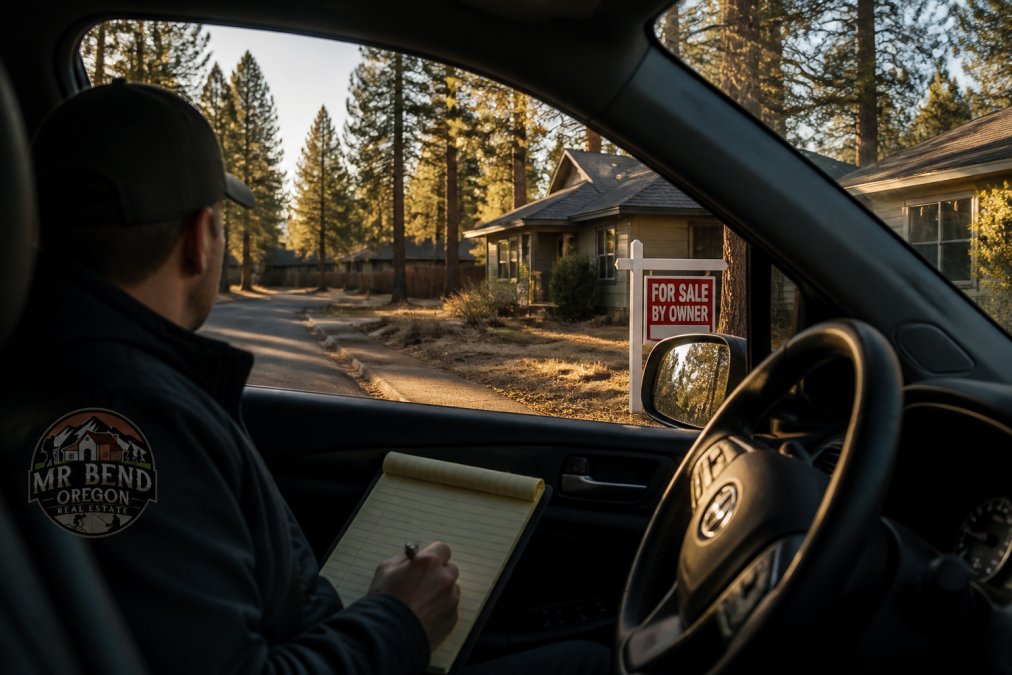
Look for these signals:
- Overgrown yards and boarded windows
- Vacant homes with piled-up mail
- For-sale-by-owner signs that look old
- Code violation notices on doors
Write down the address, snap a photo, then pull the owner’s info from public records. Add each one to your tracker.
Bend’s older neighborhoods near the river and downtown tend to hide more of these than newer subdivisions. Drive them slowly and often.
Step 5: Network With Local Investors and Real Estate Agents
Real estate networking puts deals in your inbox before they hit the market. The more people who know what you buy, the more leads you get.
Where to build your network:
- Local real estate investor meetups
- Landlord and rental property groups
- Title company and escrow events
- Online forums for Central Oregon investors
Tell everyone your buy box: the neighborhoods, price range, and property type you want. A real estate agent with deep local ties can bring you pocket listings a cash buyer never sees.
For a closer look at Bend neighborhoods before you commit, our relocation guide walks through what each area offers, and our neighbourhood tours let you preview them street by street.
Legal Protections and Due Diligence for Off Market Buyers
Off market deals skip the MLS, but they don’t skip the law. You still need a written purchase contract, a title search, and full disclosure from the seller.
Protect yourself with these steps:
- Run a title search to confirm clear ownership
- Order a home inspection before you close
- Verify there are no liens, easements, or boundary disputes
- Put every agreement in writing and signed by both sides
The Consumer Financial Protection Bureau outlines your rights around disclosures and fair lending. Read it before you sign anything.
Due diligence isn’t optional just because the deal is private. It’s your safety net.
Financing Off Market Deals in Bend and Deschutes County
Off market deals can be financed, but the loan process looks different. Lenders want a clear appraisal, and that takes extra legwork without a listing. The bigger issue is timing: in a thin-inventory market, sellers often pick the buyer who can close fastest, so your financing path is a competitive weapon, not just paperwork.
Here’s how the main paths compare.
Conventional Loans
Best when you have time and strong credit. The catch with off market properties is the appraisal, without comparable sales from an active listing, the appraiser leans on recent closed sales in the same neighborhood. If the property needs work, the appraisal can come in low or trigger repair conditions before closing.
What to prepare:
- A pre-approval letter from a lender who has closed off market deals before
- A list of recent comparable sales you pulled from Deschutes County records
- A clear explanation of any condition issues the appraiser will see
Hard Money and Bridge Loans
These are short-term, asset-based loans used when speed or property condition rules out a conventional lender. Expect higher rates and points than a conventional mortgage, shorter terms (often 6-24 months), and a focus on the property’s value rather than your income.
They make sense when:
- The seller needs to close in days, not weeks
- The property won’t pass a conventional appraisal as-is
- You plan to renovate and refinance into a long-term loan
Ask any hard money lender three questions before you sign: What’s the total cost including points and fees? What’s the exit plan if the refinance is delayed? What happens if the project runs over budget?
Cash Offers
Cash is the strongest lever in a competitive off market negotiation. It removes the appraisal contingency, shortens the timeline, and signals certainty to a seller who values privacy. If you don’t have cash yourself, a private lender or a partner can sometimes fund the deal, but put the terms in writing before you make the offer.
What Local Lenders Want to See
Talk to a local lender early, before you find a property. They’ll tell you what paperwork the property needs and how long each path takes. A few things that speed up any off market loan:
- A title search completed before you apply
- Proof of funds or a pre-approval letter ready to attach to your offer
- A written scope of work if the property needs repairs
- A realistic timeline, appraisals on off market properties often take longer than on listed homes
Key Takeaway
The best off market buyers line up financing before they find a property. Pre-approval turns a maybe into a signed contract, and in a tight market, the buyer with a clean, fast close usually wins the deal.
The best off market buyers line up financing before they find a property. Pre-approval turns a maybe into a signed contract, and in a tight market, the buyer with a clean, fast close usually wins the deal.
For a plain-language overview of your borrowing rights and the disclosures lenders must provide, the Consumer Financial Protection Bureau is a good starting point.
On Market vs Off Market: Which Path Fits Your Bend Search
On market and off market each suit different buyers. The right choice depends on your timeline, budget, and tolerance for competition.
| Factor | On Market | Off Market |
|---|---|---|
| Competition | High, multiple offers | Low, often one buyer |
| Visibility | Public listings | Private, agent-driven |
| Negotiation | Tight, less flexibility | More room to talk |
| Speed | Can move fast | Depends on seller |
| Price clarity | Market value shown | Needs your own research |
If you want selection and transparency, stay on market. If you want less competition and a quiet close, go off market. Many Bend buyers do both at once.
Conclusion: Start Your Bend Off Market Search
Finding off market properties takes patience, local knowledge, and consistent outreach. The buyers who win are the ones who build their list, follow up, and know the neighborhoods cold.
That’s where I Sell Bend Oregon comes in. With over 30 years of local experience and an eXp Realty network of 80,000+ agents, our family-led team helps you spot quiet deals before they go public. We bring deep neighborhood insight, advanced tools, and personal guidance from first search to closing.
Start your search with I Sell Bend Oregon and find the Central Oregon property that fits your goals.
Frequently Asked Questions
How do I find off market properties without a listing agent?
Start with public records and the Deschutes County property tax assessment database to identify owners and mailing addresses. Then combine driving for dollars, direct mail, and networking with local real estate investors. Off-market property search tools like PropStream or county assessor portals help you filter by equity, ownership length, and absentee status. Most deals come from consistent outreach, not a single source.
Are off market homes in Bend typically priced lower than listed properties?
Not always. Sellers who avoid the MLS often do so for privacy or speed, not because they want a discount. Some off-market deals close below market value because the property needs repairs or the seller is motivated. Others sell at or near market value because the buyer avoids competition. Always run a comparative market analysis and a home inspection before making an offer.
What role does real estate direct mail marketing play in finding off market properties?
Direct mail remains one of the most reliable ways to reach homeowners who are not actively listing. A simple letter or postcard to a targeted list, such as absentee owners or long-term holders in Deschutes County, can generate calls months later. Consistency matters more than volume. Most investors send three to five touches before getting a response.
How can networking with local investors help me find unlisted homes?
Local real estate networking groups, investor meetups, and relationships with agents give you access to pocket listings and wholesale deals before they hit the MLS. Other investors often pass on leads that do not fit their buy box. Building trust over time means you get the first call when a seller wants a quiet sale.