
Table of Contents
- What Bend Oregon Winter Weather Actually Looks Like
- Your Bend Oregon Winter Checklist: Month-by-Month Timing
- Bend Oregon Winter Home Preparation: Room by Room
- Winter Driving in Bend Oregon: Tires, Chains, and Emergency Kits
- Winterizing Outdoor Spaces: Irrigation, Plants, and Equipment
- Power Outages, Heating Failures, and Emergency Supplies
- Keeping Animals, Pets, and Livestock Supplied With Unfrozen Water
- Common Winter Preparation Mistakes New Bend Residents Make
- Conclusion: Start Your Winter Prep Before the First Snow
- Frequently Asked Questions
Last Updated: October 6, 2026
What Bend Oregon Winter Weather Actually Looks Like
Preparing for Bend Oregon winters starts with understanding one thing: this is high-desert winter, not coastal Oregon winter. At I Sell Bend Oregon, we’ve watched newcomers arrive expecting rain and gray skies, then get surprised by dry cold, bright sun, and snow that lingers in shaded areas for weeks.
Bend sits at roughly 3,600 feet, and that elevation drives everything. Daytime temperatures can climb into the 40s while nights drop well below freezing. That daily swing is the heart of winter here.
Temperature Swings, Snow Line, and Freeze-Thaw Cycles
The snow line in Central Oregon moves constantly through winter. A storm can dump snow on the west side of town and leave the east side nearly dry, all in the same afternoon.
Freeze-thaw cycles do the real damage. Water melts during the day, seeps into cracks, then freezes and expands overnight. Repeat that for three months and you understand why winter preparation matters more here than in places with steadier cold.
Wind matters too. It strips heat from homes, pushes snow into drifts, and makes a 25-degree day feel far colder.
Key Takeaway
The freeze-thaw cycle, not the total snowfall, is what damages pipes, driveways, and plants in Bend. Prep for repeated thawing and refreezing, not just for one big storm.
The freeze-thaw cycle, not the total snowfall, is what damages pipes, driveways, and plants in Bend. Prep for repeated thawing and refreezing, not just for one big storm.
Your Bend Oregon Winter Checklist: Month-by-Month Timing
A Bend Oregon winter checklist works best when you spread the work across fall instead of cramming it into one weekend. Here’s the timing we recommend to clients.
September and October: Before the First Frost
- Schedule a furnace or heat pump service before technicians book up
- Seal gaps around doors, windows, and the garage
- Blow out irrigation lines and shut off outdoor water
- Clean gutters so meltwater drains away from the roof
- Stock emergency supplies before storm-season shelves empty out
November Through February: Peak Winter Maintenance
- Keep walkways and driveways clear of snow and ice
- Check pipe insulation in crawl spaces and the garage
- Replace furnace filters monthly during heavy use
- Watch indoor humidity and adjust as needed
- Keep a winter emergency kit in every vehicle
| Timing | Task | Why It Matters |
|---|---|---|
| September | Service heating system | Techs book out fast by October |
| October | Blow out irrigation lines | Prevents burst pipes underground |
| November | Insulate exposed pipes | Stops freeze-thaw damage |
| December-February | Monitor humidity and filters | Keeps air healthy and heat efficient |
If you’re still house hunting, our relocation guide walks through how to time a move around these seasonal demands.
Bend Oregon Winter Home Preparation: Room by Room
Bend Oregon winter home preparation comes down to three things: heat stays in, water keeps moving, and air stays breathable. Work through your home one zone at a time.
Protecting Pipes and Plumbing From Freezing
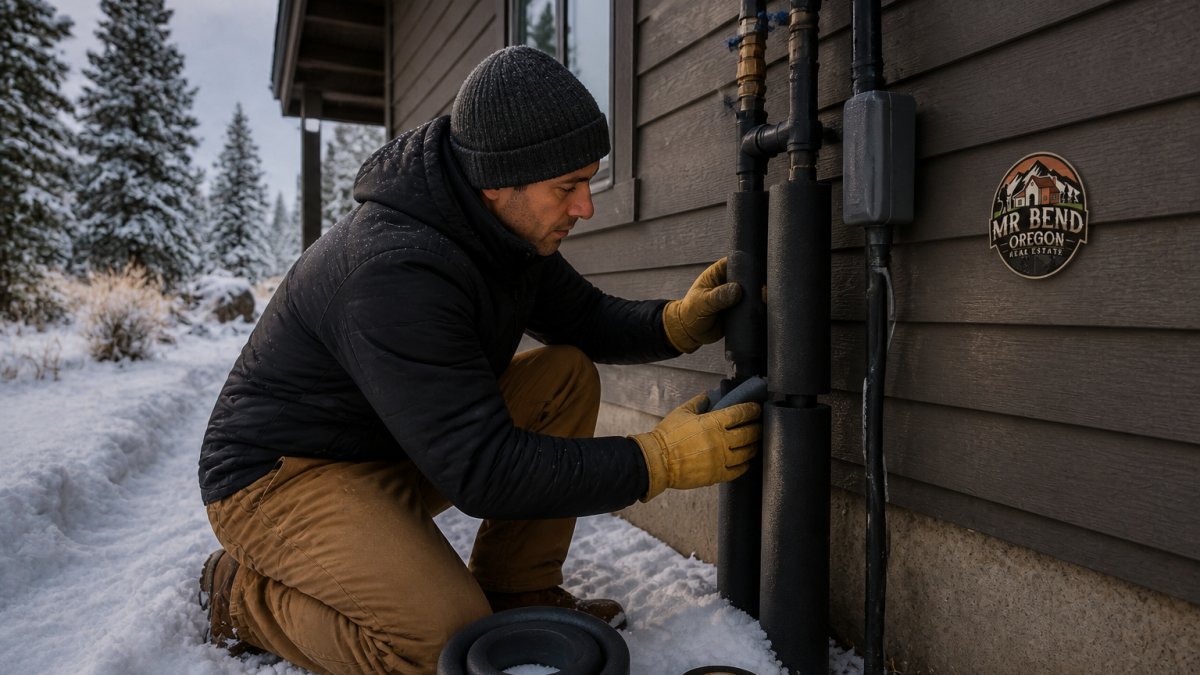
Pipes in crawl spaces, garages, and exterior walls freeze first. These areas get cold fast and stay cold.
- Insulate exposed pipes with foam sleeves
- Disconnect garden hoses and drain outdoor spigots
- Let a thin trickle run from the faucet farthest from your water heater on the coldest nights
- Open cabinet doors under sinks on exterior walls so warm air reaches the pipes
- Know where your main water shutoff is before you need it
A common mistake is ignoring the garage. An unheated garage can drop below freezing and take the water line running through it with it.
Indoor Humidity and Dry Air in Heated Homes
Heated air dries out fast in Bend. Many homes settle into the low teens for relative humidity, which dries out skin, wood floors, and door frames.
Aim for 30% to 40% RH indoors. A hygrometer costs little and tells you exactly where you stand. If you’re running low, a whole-home humidifier attached to your furnace handles the whole house. A portable unit with a water pan works for a single room, but you’ll refill it daily.
Pro Tip
Wood floors and cabinetry in Bend homes shrink and crack in dry winter air. Keep relative humidity near 35% and you’ll protect your floors as much as your sinuses.
Wood floors and cabinetry in Bend homes shrink and crack in dry winter air. Keep relative humidity near 35% and you’ll protect your floors as much as your sinuses.
Winter Driving in Bend Oregon: Tires, Chains, and Emergency Kits
Winter driving in Bend Oregon is manageable with the right setup. The trouble usually comes from drivers who moved here from places without real winter.
Snow tires beat all-season tires on cold pavement, even when the road looks clear. Studded tires are legal in Oregon only during winter months, so check the current dates with the Oregon Department of Transportation before you install them.
Carry chains or traction devices. Some mountain passes require them by law, and the National Weather Service will flag those conditions before you leave.
Build a vehicle emergency kit:
- Blanket and extra warm layers
- Flashlight with spare batteries
- Ice scraper and snow brush
- Jumper cables
- Non-perishable snacks and water
- Phone charger and a printed list of emergency contacts
Checking Road Conditions and Cameras Before You Leave
Check road cameras and the weather forecast before any winter trip. TripCheck cameras show live conditions at passes and major intersections.
Watch for icy bridges and shaded areas. Bridges freeze before the road surface because cold air moves under them. Shaded stretches along tree-lined roads stay icy long after the sun hits everything else.
Leave extra following distance. On ice, stopping takes far more room than most drivers expect. And if you don’t need to travel during an active storm, stay home.
Winterizing Outdoor Spaces: Irrigation, Plants, and Equipment
Outdoor water lines cause some of the most expensive winter damage in Central Oregon, and the reason is the freeze-thaw cycle rather than a single deep freeze. Water left in an underground irrigation line expands when it freezes, then contracts as it thaws, then expands again the next night. Over a winter of that cycling, even flexible poly pipe cracks at fittings and elbows. That is why the irrigation blowout is not optional here.
Shutting Down Irrigation Before the First Hard Freeze
Aim to complete the blowout in October, before nighttime temperatures consistently drop below freezing. The snow line in Central Oregon moves constantly, so a mild October can lull you into waiting too long.
Steps most irrigation professionals follow:
- Shut off the main valve feeding the irrigation system, then open a drain or test port to release standing water
- Use an air compressor sized to the system’s zone count to push water out of each zone, one at a time, until only air escapes the heads
- Open and drain any backflow preventer or vacuum breaker, which is the component most likely to crack first
- Disconnect and drain exterior hose bibs, then install an insulated cover if the bib sits on a north- or east-facing wall
- Coil and store hoses indoors; a hose left connected traps water in the bib and splits the pipe behind the wall
A common pattern is a homeowner who blows out the zones but forgets the backflow assembly. That single brass component can fail and send water into the foundation wall when the system is charged again in spring.
Protecting Plants Through Repeated Thawing and Refreezing
Plants in Central Oregon face a different stress than plants in steadily cold climates. A 45-degree afternoon followed by a 20-degree night pushes sap to move and then freeze, which splits bark and heaves shallow roots out of the soil.
- Apply two to four inches of mulch around perennials and shrubs after the ground cools but before it freezes hard, so the soil temperature stays steady
- Wrap the trunks of young trees with breathable trunk guards to prevent sunscald and frost cracking on the south and west sides
- Water evergreens during dry, mild spells; a dehydrated evergreen is more likely to suffer winter burn than a hydrated one
- Move potted plants into an unheated garage or indoors, and group them so they shelter each other
- Leave spent perennial foliage standing through winter; it insulates the crown and feeds beneficial insects
Storing Equipment and Outdoor Water Tools
Drain and store hoses, pressure washers, sprinklers, and any tool that holds water. Gas-powered tools should get a fuel stabilizer or run dry before storage, because stale fuel gums carburetors over the cold months. Store propane tanks upright and outside, never in a garage or basement.
Watch Out
Skipping the irrigation blowout is the single most common and costly mistake. Water left in underground lines freezes, expands, and cracks the pipe, and the repair often means digging up landscaping. The backflow preventer and any above-ground valves fail first.
Skipping the irrigation blowout is the single most common and costly mistake. Water left in underground lines freezes, expands, and cracks the pipe, and the repair often means digging up landscaping. The backflow preventer and any above-ground valves fail first.
Pro Tip
If you are new to a home with an irrigation system, ask the previous owner or a neighbor which zones drain to which low points. Central Oregon properties often have slopes and buried lines that are not obvious from the surface.
If you are new to a home with an irrigation system, ask the previous owner or a neighbor which zones drain to which low points. Central Oregon properties often have slopes and buried lines that are not obvious from the surface.
Power Outages, Heating Failures, and Emergency Supplies
Winter storms knock out power in Bend, and a heating failure during a cold snap turns serious fast. Plan for both.
Keep on hand:
- Flashlights and extra batteries
- Battery-powered or hand-crank radio
- Three days of water and non-perishable food
- A backup heat source rated for indoor use
- Extra blankets and sleeping bags
- A full tank of propane if you grill or use a portable heater
Never run a generator, camp stove, or charcoal grill indoors. Carbon monoxide kills quietly, so install a CO detector on every level of your home. The Centers for Disease Control and Prevention tracks carbon monoxide deaths each year and points to generators as a leading cause during outages.
If your furnace fails, close off unused rooms and let a trickle of water run overnight to keep pipes from freezing while you wait for a repair.
Keeping Animals, Pets, and Livestock Supplied With Unfrozen Water
Frozen water is a daily winter battle for anyone with pets or livestock in Central Oregon, and the stakes are higher than most newcomers realize. Animals drink less when water is ice cold, and a horse, cow, or dog that drinks less is more prone to colic, impaction, and dehydration, problems that are harder to treat in cold weather and can become emergencies.
Pets
- Check outdoor bowls several times a day; a bowl that is liquid at noon can be solid by 4 p.m. once the sun drops behind the Cascades
- Switch to a heated bowl for outdoor animals; most run on a standard outlet and use less power than people expect
- Wipe paws after walks to remove ice-melt chemicals, which irritate pads and can be toxic if licked off
- Bring pets inside during the coldest nights; a garage or insulated shelter works for outdoor animals, but it needs dry bedding and a wind block
- Watch older pets and short-coated breeds closely; they lose body heat faster than they can replace it
Livestock
Livestock owners in Central Oregon typically rely on tank heaters or insulated troughs to keep water from freezing. If you do not have a heater, break surface ice at least twice daily, once in the morning and once in the evening, and remove the ice rather than leaving it floating, so animals can drink without pushing through slush.
A few practices that make winter watering easier:
- Site troughs where they get sun exposure during the day and shelter from prevailing wind
- Insulate exposed water lines to troughs the same way you would insulate household pipes
- Check heaters and cords for damage before the first hard freeze; a failed heater discovered during a cold snap is a difficult fix
- Keep a backup water source, such as filled buckets indoors, in case a line freezes or power goes out
- Provide salt or mineral blocks so animals drink enough to stay hydrated
A Note for Renters and Newcomers
If you rent and keep animals, confirm with your landlord who is responsible for winterizing outdoor water lines and who supplies heated bowls or tank heaters. In Central Oregon, that responsibility is often split, and clarifying it before the first freeze prevents both frozen pipes and disputes.
Pro Tip
If you are new to keeping livestock here, ask a neighbor who has wintered animals in Central Oregon what they use for tank heaters and how they handle power outages. Longtime residents know which setups survive a multi-day cold snap and which do not.
If you are new to keeping livestock here, ask a neighbor who has wintered animals in Central Oregon what they use for tank heaters and how they handle power outages. Longtime residents know which setups survive a multi-day cold snap and which do not.
Key Takeaway
Unfrozen water is not just a comfort issue for animals, it is a health issue. Plan for at least two water checks per day, a backup heat source for troughs, and a plan for power outages.
Unfrozen water is not just a comfort issue for animals, it is a health issue. Plan for at least two water checks per day, a backup heat source for troughs, and a plan for power outages.
Common Winter Preparation Mistakes New Bend Residents Make
New residents repeat the same mistakes every year. Here’s what we see most often.
- Waiting until the first snow. By then, furnace techs are booked and stores are picked clean.
- Ignoring indoor humidity. Dry air damages floors, furniture, and your own comfort.
- Skipping the irrigation blowout. This one leads to cracked underground lines and costly repairs.
- Running all-season tires all winter. They lose grip fast on cold pavement.
- Forgetting the garage. Unheated garages freeze pipes and ruin stored paint and liquids.
- No emergency kit in the car. A breakdown on a mountain pass is a very different problem without supplies.
Pro Tip
If you’re new to town, ask a neighbor who’s been through a few Bend winters what they do. Longtime residents know which streets ice up first and which side of town gets the most snow.
If you’re new to town, ask a neighbor who’s been through a few Bend winters what they do. Longtime residents know which streets ice up first and which side of town gets the most snow.
Want a feel for the neighborhoods before you commit? Our neighborhood tours on YouTube give you a look at what winter looks like block by block.
Conclusion: Start Your Winter Prep Before the First Snow
Bend Oregon winters reward the prepared and surprise everyone else. The work is not hard, but it has to happen before the cold arrives.
If you’re buying or selling a home in Bend, Redmond, or Deschutes County, our team at I Sell Bend Oregon brings over 30 years of local experience to every transaction. We know which neighborhoods handle winter well and which homes need extra prep before you move in. Reach out to Paul Frazier and the team, or subscribe to Mr. Bend Oregon real estate on YouTube for local tips all year long.
Start your search with I Sell Bend Oregon and get a winter-ready home in Central Oregon.
Frequently Asked Questions
What are Bend Oregon winters like?
Bend winters bring cold temperatures, frequent snow, and a snow line that shifts with elevation. Days often warm above freezing, then refreeze overnight, creating freeze-thaw cycles that stress pipes, pavement, and plants. Dry air and wind are common, so heated homes lose indoor humidity fast. Conditions vary block to block depending on elevation and whether you sit in a shaded area. That variability is why a single ‘one-size’ winter plan rarely works here; timing your prep to your specific neighborhood matters more than following a generic checklist.
Do I need snow tires to drive in Bend during winter?
Many Bend residents run dedicated snow tires or three-peak-mountain-snowflake-rated all-weather tires from roughly November through March. Studded tires are legal in Oregon only during a set seasonal window, so check current dates before installing them. If you drive mountain passes or Forest Service roads, carry chains or traction devices even with snow tires. Icy bridges, shaded curves, and side streets often stay slick longer than main roads. Whatever you choose, test your traction in an empty lot before you rely on it in traffic.
How do I protect pipes from freezing during a Bend winter?
Disconnect garden hoses, shut off and drain outdoor spigots, and insulate exposed pipes in crawl spaces, garages, and along exterior walls. During hard freezes, let a pencil-thin stream drip from the faucet farthest from your water heater and open cabinet doors under sinks on exterior walls so warm air reaches the pipes. If you leave town, keep the thermostat set no lower than the mid-50s rather than shutting heat off entirely. Know where your main water shutoff is before you need it.
What should I keep in my car for winter driving around Bend?
Pack an emergency kit before the first storm: blankets or a sleeping bag, gloves, a hat, waterproof boots, a flashlight with extra batteries, jumper cables or a jump pack, an ice scraper, a small shovel, sand or kitty litter for traction, a phone charger, water, and non-perishable snacks. Add a first-aid kit and any medications you rely on. Check road conditions and cameras before you leave, allow extra following distance on icy roads, and tell someone your route and expected arrival time on longer trips.