
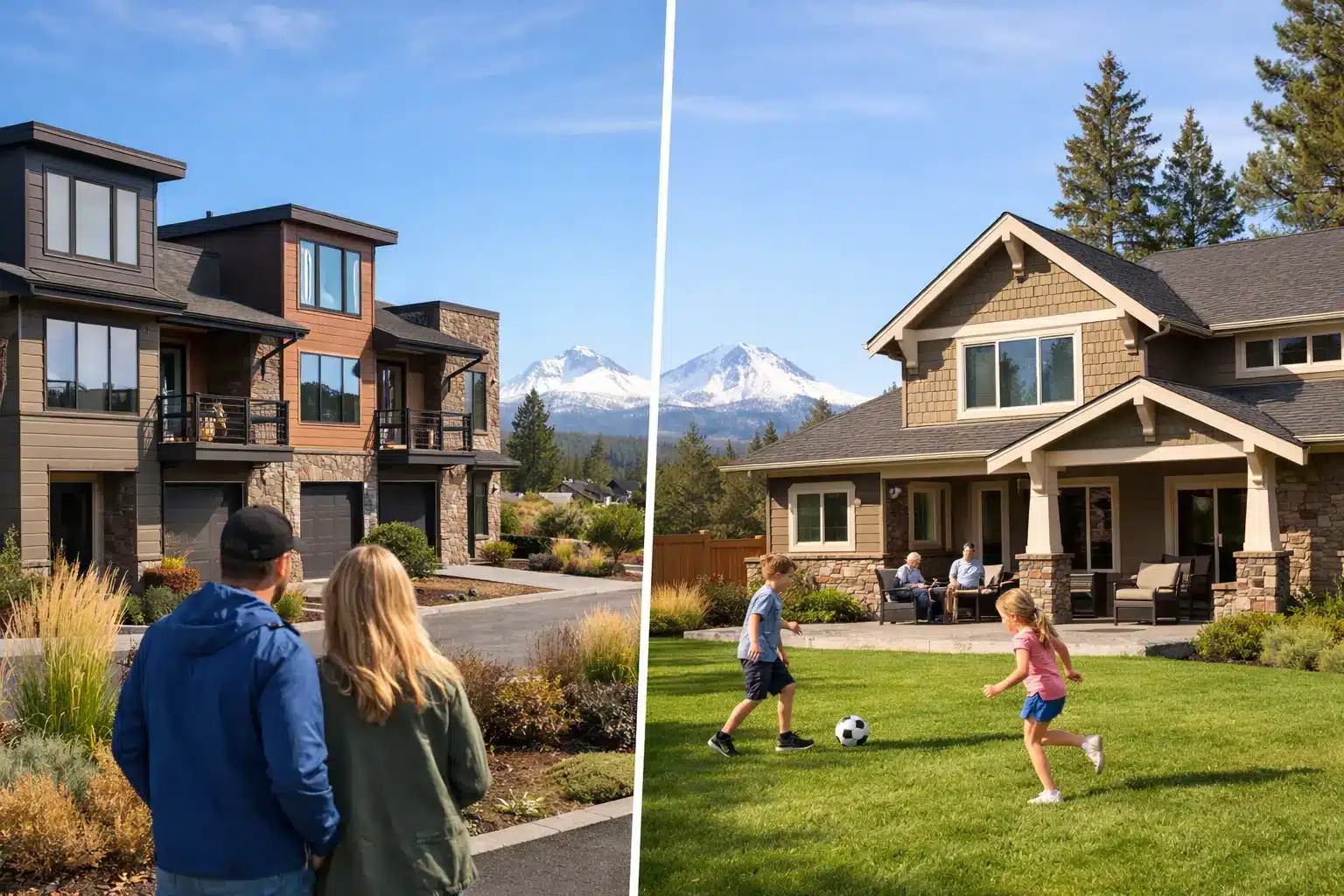
A townhome or single family home can look like a simple choice on a search portal. In Bend, it is usually a lifestyle decision first and a square-footage decision second. The right fit depends on how you want to spend your weekends, how much privacy matters, where you want to be close to, and whether the home needs to work for your life five or ten years from now.
For buyers relocating to Central Oregon, this decision can feel even bigger. A townhome may offer an easy landing spot near trails, restaurants, and daily conveniences. A single-family home may deliver the yard, garage space, and breathing room that prompted the move in the first place. Neither is automatically better. The best choice is the one that matches your actual priorities, not just the listing photos.
Townhome or Single Family: Start With Your Daily Life
Before comparing prices, picture an ordinary Tuesday and an ideal Saturday. Do you want to walk out the door for coffee, dinner, or an evening along the Deschutes River? Would you rather have a private backyard for a dog, gardening, visiting family, or simply a quiet place to sit? Do you travel often, or does the thought of exterior chores feel like part of homeownership rather than a burden?
Townhomes often appeal to buyers who value a more lock-and-leave lifestyle. Depending on the community, an HOA may handle exterior maintenance, landscaping in common areas, roof replacement planning, or snow removal from shared streets and sidewalks. That can be a meaningful advantage for frequent travelers, second-home buyers, or anyone who wants fewer weekend projects.
Single-family homes generally offer more control. You may have your own driveway, a larger garage, more outdoor space, and fewer shared walls. That independence is appealing, but it also means the upkeep is yours. Roofs, fences, landscaping, irrigation, exterior paint, and repairs require both attention and budget.
The question is not whether maintenance is good or bad. It is whether you want to direct your time and money yourself or prefer a community structure that handles certain responsibilities for you.
Privacy, Noise, and Outdoor Space
Shared walls are one of the clearest practical differences. A well-built townhome can feel very private, but buyers should never assume it will. Visit at different times if possible. Listen for street activity, nearby garages, and the normal rhythm of the neighborhood. Ask about construction type and review any available information on sound separation.
A single-family home typically provides more distance from neighbors, though lot size varies widely across Bend and Redmond. Some newer neighborhoods have compact lots and homes positioned close together. Other areas offer wider setbacks, mature landscaping, or more room between homes. “Single family” does not automatically mean secluded, just as “townhome” does not automatically mean noisy.
Outdoor space is another place where the details matter. A townhome may have a patio, courtyard, balcony, or small fenced area that is easy to enjoy without becoming a major project. A single-family home may provide room for raised beds, a play area, outdoor dining, storage, or future improvements. If a yard is central to your vision, make it a non-negotiable in your search rather than assuming you can create one later.
Garage and storage deserve more attention than most buyers give them
Central Oregon buyers often have gear. Bikes, skis, paddleboards, camping equipment, golf clubs, tools, and seasonal items need a home too. A townhome with a true two-car garage and thoughtful storage may serve an active household better than a larger house with a one-car garage or an awkward layout.
When touring, look beyond the garage door count. Check usable depth, ceiling height, storage niches, driveway access, and whether HOA rules limit where recreational equipment, trailers, or additional vehicles can be kept. Those details can affect day-to-day satisfaction far more than a slightly larger living room.
Understand HOA Costs Before Comparing Prices
A townhome’s monthly HOA dues are not simply an extra line item. They are part of the cost of owning the home, and they should be evaluated alongside purchase price, property taxes, insurance, utilities, and expected maintenance.
Higher dues are not automatically a red flag. They may reflect meaningful services, well-maintained common areas, exterior coverage, or reserves for major future work. On the other hand, low dues are not always a bargain if the association has limited reserves or upcoming projects that could lead to special assessments.
Before committing to a townhome, review the HOA documents carefully. Pay attention to the budget, reserve funding, insurance coverage, meeting minutes, pending assessments, rental restrictions, pet rules, parking policies, and architectural guidelines. A local agent can help you identify the questions to ask, but buyers should take the documents seriously and consult the appropriate professionals when needed.
Single-family homes can also be part of an HOA. In that case, the dues may be lower because they cover community standards or shared amenities rather than exterior building maintenance. The same rule applies: know what you are paying for, what rules apply, and what future obligations may exist.
Location Can Change the Equation
In Bend, location can make a townhome especially compelling. A well-placed townhome near downtown, the Old Mill District, Northwest Crossing, or a neighborhood commercial center can put daily errands and recreation close at hand. For a buyer who wants to spend less time driving, that access may outweigh the appeal of a larger private lot farther out.
A single-family home can open different possibilities. It may offer more space in established neighborhoods, a quieter street, or proximity to the schools, parks, and routes that work best for your household. In Redmond and across Deschutes County, buyers may also find that a detached home delivers more value per square foot in certain locations, though that varies by neighborhood, condition, lot, and current inventory.
Rather than asking which property type is the better investment, ask which location and property combination will remain useful to you. A well-located townhome with strong demand can be a smart long-term choice. So can a single-family home with a functional layout, desirable setting, and room for changing needs. Real estate value is never just about the building type.
Flexibility for the Next Chapter
Think ahead, but do not overbuy for a hypothetical future. A first-time buyer may prefer a townhome that keeps the payment and maintenance manageable while building equity. A retiree may choose one-level single-family living to avoid stairs and preserve private outdoor space. A growing family may need extra bedrooms, a fenced yard, and the flexibility of a detached home.
For investors or buyers who may eventually rent the property, rules matter. Townhome communities sometimes have rental caps, minimum lease periods, or other restrictions. Single-family homes may also be subject to neighborhood covenants. Never rely on assumptions based on property type alone. Confirm the current rules before making plans around future use.
Resale deserves consideration as well. Homes with intuitive layouts, adequate parking, useful storage, and a location that supports the local lifestyle tend to have broader appeal. A townhome can be an excellent resale property when it is well maintained and positioned in a desirable community. A single-family home can lose appeal if its upkeep needs are far beyond what typical buyers expect. Condition and usability count.
Make the Comparison With Real Numbers
Once you have identified a few serious options, compare them on one page. Include the purchase price, estimated monthly payment, HOA dues, insurance, utilities, likely maintenance, commute patterns, garage and storage, outdoor space, and any immediate improvements needed. This turns a vague emotional decision into a clear conversation.
It also helps to distinguish between a compromise and a deal breaker. Maybe a smaller yard is acceptable if the location is exceptional. Maybe HOA dues are worthwhile if they remove responsibilities you do not want. But if you know you need space for two vehicles, a workshop, or a dog that needs a secure yard, do not talk yourself out of those requirements just because a home is polished and newly listed.
The Frazier family team has spent decades helping buyers look past the surface details and match homes to the way people actually live in Central Oregon. A thoughtful tour plan, a close read of the documents, and honest local perspective can save you from buying a home that works on closing day but not six months later.
The best next step is to tour both styles with your own priorities in hand. Pay attention to how each home feels when you picture your routines there. The right home is not the one that wins every category. It is the one that makes the trade-offs feel worthwhile.