

Table of Contents
- Start With a Local Market Analysis and Cost of Living Research
- Get Mortgage Pre-Approval Before You Shop
- The Value of Hiring a Local Real Estate Agent
- How Virtual Home Tours for Buyers Reduce Risk
- Your Remote Home Buying Checklist for a Smooth Process
- Budgeting for Closing Costs and Moving Expenses
- Tax Implications and Remote Closing Logistics
- Evaluating Neighborhoods and Lifestyle Transition Planning
- Conclusion: Your Next Steps as an Out of State Buyer
- Frequently Asked Questions
Last Updated: September 15, 2026
Start With a Local Market Analysis and Cost of Living Research
Buying a home from another state starts with the numbers, not the listings. Tips for out of state home buyers that skip straight to browsing photos usually end in regret, because the price tag tells you almost nothing about what a place actually costs to live in.
At I Sell Bend Oregon, we’ve watched too many buyers fall in love with a house before they understood the market around it. So start here:
- Pull recent sale prices for comparable homes, not asking prices
- Check property taxes by county, since rates vary block to block
- Estimate utilities, insurance, and commute costs before you commit
- Compare the local job market and wage levels against your current income
A market analysis tells you whether you’re buying into a rising, flat, or cooling area. Cost of living research tells you whether you can actually afford to stay there. Both matter more than the paint color.
Pro Tip
Ask for sold comps from the last 90 days, not the last 12 months. In a shifting market, year-old sales data will mislead you about what your offer should look like.
Ask for sold comps from the last 90 days, not the last 12 months. In a shifting market, year-old sales data will mislead you about what your offer should look like.
Get Mortgage Pre-Approval Before You Shop
Pre-approval is a lender’s written estimate of how much it will lend you, based on verified income, assets, and credit. It is not the same as pre-qualification, which is a rough guess with no documentation behind it.
For out of state home buyers, pre-approval does two things at once. It tells you your real budget, and it signals to sellers that you’re serious. In competitive markets, a seller may not even consider an offer without it.
Gather your documents early: pay stubs, tax returns, bank statements, and proof of any down payment gifts. Then ask your mortgage lender two questions most buyers forget:
- Can you lend in the state I’m moving to, and are you licensed there?
- How long is this pre-approval valid, and what could void it?
The second question matters. Changing jobs, financing a car, or opening a new credit card between pre-approval and closing can sink your loan. Keep your financial profile still until you have keys in hand.
The Value of Hiring a Local Real Estate Agent
Hiring a local real estate agent is the single highest-use decision an out of state buyer makes. A good agent knows which streets flood, which neighborhoods have HOA quirks, and which listings are priced to sit.
This is where remote buyers get burned most often. Photos hide a lot. A local agent walks the property, notices the cracked foundation, and tells you what the seller won’t.
What separates a genuinely local agent from a directory listing is access to information that never hits the public sites. Off-market inventory, contractor referrals, and honest read on whether a neighborhood fits your lifestyle. We built our relocation services around exactly that gap, because a buyer three states away needs a set of eyes they can trust.
Ask any agent you interview:
- How many transactions have you closed in this specific area?
- Will I work with you directly, or be handed to an assistant?
- Can you walk a property for me on video before I fly out?
Watch Out
A common mistake is hiring an agent who is a friend of a friend in your current city. They cannot tour homes for you, and they won’t know the local ordinances, zoning laws, or permit rules that affect your purchase.
A common mistake is hiring an agent who is a friend of a friend in your current city. They cannot tour homes for you, and they won’t know the local ordinances, zoning laws, or permit rules that affect your purchase.
How Virtual Home Tours for Buyers Reduce Risk
Virtual home tours for buyers replace the in-person walkthrough with live video, recorded walkthroughs, and detailed photo sets. Done well, they cut the risk of a sight-unseen purchase dramatically.
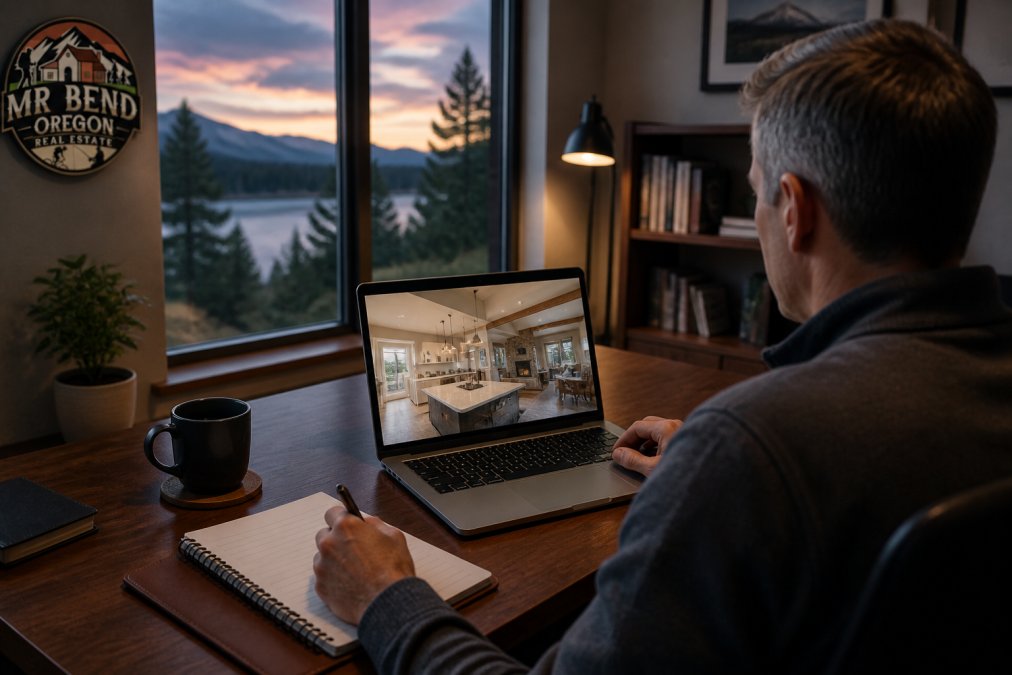
The key word is “done well.” A shaky phone video tells you nothing. A proper remote tour should include:
- A live video call where you direct the agent where to point the camera
- Close-ups of the roof, HVAC, water heater, and electrical panel
- Sound checks for traffic noise, neighbors, and nearby commercial activity
- A walk of the immediate block, not just the property line
Ask your agent to film during the day and again at dusk. Neighborhoods change character after dark, and that’s information a listing photo will never give you. If a seller refuses a live tour, treat that as a red flag, not a minor inconvenience.
Your Remote Home Buying Checklist for a Smooth Process
A remote home buying checklist keeps a long-distance purchase from turning into a pile of missed deadlines. Here’s the sequence that works:
- Get mortgage pre-approval from a lender licensed in the destination state
- Hire a local real estate agent with verified area experience
- Set your must-haves versus nice-to-haves before touring
- Schedule live virtual tours and request a video walkthrough of each home
- Order a home inspection, and attend the debrief by phone or video
- Review the appraisal and confirm it supports your offer price
- Arrange title insurance and confirm escrow instructions
- Plan the remote closing, including notary and power of attorney options
- Book your moving company and set utility setup dates
- Confirm your earnest money deposit is held correctly in escrow
Print this. Check items off in order. The buyers who struggle are almost always the ones who skipped a step and tried to backfill it later.
Budgeting for Closing Costs and Moving Expenses
Closing costs are the fees and prepaid items you pay at settlement, and they typically run alongside your down payment, not instead of it. For out of state buyers, they’re easy to underestimate because there are two sets of costs: the purchase, and the move.
Budget for these closing costs:
- Loan origination and underwriting fees
- Appraisal and home inspection
- Title insurance and escrow fees
- Property taxes and prepaid interest
- Recording fees and any HOA transfer charges
Then add the relocation side: moving company quotes, temporary housing, storage, and the cost of setting up utilities at the new address. Get at least two moving quotes, and ask whether the estimate is binding or non-binding. A non-binding estimate can climb fast.
Key Takeaway
The most common budget mistake is treating closing costs as a small add-on. Build them into your total cash-to-close figure from day one, before you set your offer ceiling.
The most common budget mistake is treating closing costs as a small add-on. Build them into your total cash-to-close figure from day one, before you set your offer ceiling.
Tax Implications and Remote Closing Logistics
Interstate moves raise tax and closing questions that a same-city purchase never does. Most guides wave at this topic and move on. Here is the actual mechanics, so you can ask the right questions before you sign anything.
Tax angles that change your numbers
- Residency and domicile. States use different tests to decide whether you are a resident for income tax purposes. Common factors include where you spend the most nights, where you register to vote, where your driver’s license is issued, and where your primary residence sits. Some states publish a “domicile” checklist; others rely on case law. A tax professional licensed in both states can map your situation.
- State income tax on the way in and out. A handful of states levy no personal income tax at all, while others tax wages, retirement distributions, and capital gains at different rates. If you are moving from a no-income-tax state to one with an income tax (or the reverse), your take-home pay can shift meaningfully even at the same salary.
- Property tax reassessment. Many states cap annual property tax increases for long-time owners but reset the assessed value to market when a property sells. That means the seller’s tax bill is often not your tax bill. Ask the county assessor’s office what the reassessment rule is for your specific parcel.
- Capital gains on a prior home. If you are selling where you came from, the federal Section 121 exclusion (up to $250,000 of gain for a single filer, $500,000 for a married couple filing jointly) generally requires that you owned and lived in the home as your primary residence for two of the five years before the sale. Moving early can shrink or eliminate that exclusion. Timing the sale relative to the purchase matters.
- Homestead exemptions. Many states offer a property tax break for owner-occupied primary residences, but you usually have to file for it, often within a window after closing. Miss the window and you wait a year.
Talk to a CPA or enrolled agent who works in both states before you close, not after. The cost of one consultation is almost always less than the cost of a filing mistake.
Remote closing logistics, step by step
Most out-of-state buyers never set foot in a title office. That is normal, but it requires planning.
- Confirm the closing method early. Ask your escrow officer whether the state where the property sits allows Remote Online Notarization (RON). RON rules are set state by state, and some states require traditional in-person notarization for real estate documents. If RON is not available, you will need a mobile notary near you or a power of attorney.
- Decide on a power of attorney (POA). A limited POA lets someone you trust sign specific documents on your behalf at the closing table. Lenders and title companies each have their own POA requirements, and some will not accept one for certain documents. Get approval in writing before the POA is drafted.
- Review the Closing Disclosure. Federal rules require your lender to deliver the Closing Disclosure at least three business days before consummation. Use those three days to compare it line by line against your Loan Estimate. If numbers moved, ask why in writing.
- Wire funds safely. Wire fraud is the single biggest financial risk in a remote closing. Criminals spoof title company emails and send fake wiring instructions. Always call the title company at a phone number you independently verified, not one from an email, and read the account numbers back. Many title companies now offer a fraud-prevention callback service; use it.
- Get the final documents. After closing, you should receive a signed deed, the Closing Disclosure, title insurance policy, and any transfer paperwork. Store digital and physical copies.
IRS guidance on the Section 121 home sale exclusion
Watch Out
Never wire earnest money or down payment funds based on instructions that arrive only by email. Verify by phone with a known contact at the title company before any transfer.
Never wire earnest money or down payment funds based on instructions that arrive only by email. Verify by phone with a known contact at the title company before any transfer.
Evaluating Neighborhoods and Lifestyle Transition Planning
Neighborhood demographics, commute time, and access to amenities decide whether you will be happy long after the closing paperwork is filed. This is the part buyers rush, and it is the part they regret.
Build a shortlist of three to five neighborhoods, then score each one on what actually matters to you:
| Factor | What to Check | Why It Matters |
|---|---|---|
| Commute time | Drive it at rush hour, not midday | Daily stress and fuel costs |
| Schools | District boundaries, not just city | Boundaries shift between streets |
| Amenities | Grocery, medical, parks within range | Daily convenience |
| Safety | Local crime data and a nighttime drive | Peace of mind |
| Zoning laws | Local ordinances on short-term rentals, ADUs | Limits what you can do with the property |
How to vet a neighborhood you cannot visit
Most guides stop at the table above. The harder problem is that you are judging a place you have never lived in. Here is how to close that gap.
- Use the school district’s own boundary tool, not a third-party map. District websites publish attendance-zone lookups by address. Third-party sites are often out of date, and a house on the wrong side of a street can feed to a different school.
- Pull the district’s report card. Every state publishes school performance data, test scores, graduation rates, class sizes. Read the trend over three to five years, not a single year.
- Check the commute with a real routing tool at the actual time you would drive it. A 20-minute midday drive can be 50 minutes at 7:45 a.m. If you will commute daily, this is the single biggest lifestyle factor after housing cost.
- Look up the local police department’s crime map or the FBI’s Uniform Crime Reporting data for the jurisdiction. Compare the neighborhood to the citywide average, not to a national one.
- Read the local newspaper and the city council agenda. Rezoning requests, new developments, and road projects show up there months before they show up in listings.
- Join a neighborhood Facebook group or Nextdoor for the area. You will see what residents actually complain about, and what they love.
Lifestyle transition planning
A house can be perfect and the location still wrong. Before you commit, map the anchors of your daily life:
- Healthcare. If you have a specialist or a chronic condition, confirm there is a provider in-network within a reasonable drive. Call the office and ask about new-patient wait times.
- Schools and childcare. Waitlists for daycare and preschool can run months. Start inquiries as soon as you have a target neighborhood.
- Social and community ties. Places of worship, clubs, volunteer organizations, and hobby groups are how most people rebuild a social circle after a move. Identify two or three before you arrive.
- Climate and seasonal reality. Averages hide extremes. Look up the record high and low, average snowfall, and typical humidity for the area, not just the annual mean.
- Services you use weekly. Hair stylist, veterinarian, gym, favorite grocery chain. Knowing whether they exist nearby prevents small daily frustrations from compounding.
Pro Tip
Drive your top neighborhood at 8 a.m. and again at 6 p.m. on a weekday. Traffic patterns and street noise tell you more about daily life than any listing description ever will.
Drive your top neighborhood at 8 a.m. and again at 6 p.m. on a weekday. Traffic patterns and street noise tell you more about daily life than any listing description ever will.
Key Takeaway
The transaction ends at closing. The lifestyle starts the day you move in. Spend as much research time on the second as you do on the first.
The transaction ends at closing. The lifestyle starts the day you move in. Spend as much research time on the second as you do on the first.
Conclusion: Your Next Steps as an Out of State Buyer
The distance is the challenge, and it’s a solvable one. Start with market research and pre-approval, hire someone local who will actually walk the property for you, tour remotely with a critical eye, and budget for both the closing and the move.
This is the work I Sell Bend Oregon has done for relocating buyers for over 30 years. Led by Paul Frazier and affiliated with eXp Realty, our family-led team knows the neighborhoods, the market, and the lifestyle questions that matter when you’re moving from out of state. We offer relocation guidance and neighborhood tours built for buyers who can’t be here in person. You can find more insights on our YouTube channel, Mr. Bend Oregon Real Estate.
Get started with I Sell Bend Oregon and make your move with a local team in your corner.
Frequently Asked Questions
What are the biggest challenges when buying a home from another state?
The main challenges include not being able to visit properties in person, understanding local market conditions, and managing the closing process remotely. You may also face difficulties with timing your move and coordinating inspections. Working with a local real estate agent who can provide video walkthroughs and detailed neighborhood insights helps reduce these risks significantly.
Do I need a local real estate agent if I am buying from out of state?
Yes, hiring a local real estate agent is one of the most important steps for out of state home buyers. An agent provides on-the-ground knowledge of neighborhoods, market trends, and local ordinances that you cannot get from online listings alone. They can attend showings, coordinate inspections, and advocate for you during negotiations, which is especially valuable when you cannot be there in person.
How does the closing process differ for out-of-state buyers?
Remote closings often involve electronic signatures and wire transfers instead of in-person meetings. You will need to coordinate with a title company and escrow officer who can handle your paperwork digitally. Some states require a remote online notarization, so confirm your lender and title company support this. Planning ahead for these logistics prevents delays in your closing timeline.
What should I look for in a neighborhood when I am not familiar with the area?
Focus on commute times, school ratings, crime statistics, and access to amenities like grocery stores and healthcare. Ask your real estate agent for a video walkthrough of the neighborhood at different times of day. Reviewing neighborhood demographics and local ordinances also helps you understand if the area fits your lifestyle before you commit to a sight-unseen purchase.